
On screen: A battered bronze helmet with a red horsehair crest lying in the surf on a black sand beach at dawn.
The Odyssey
ΟΔΥΣΣΕΙΑThe Odyssey · thirteen scenes from the long way home
ἄνδρα μοι ἔννεπε, μοῦσα, πολύτροπον
Tell me, Muse, of the man of many turns.
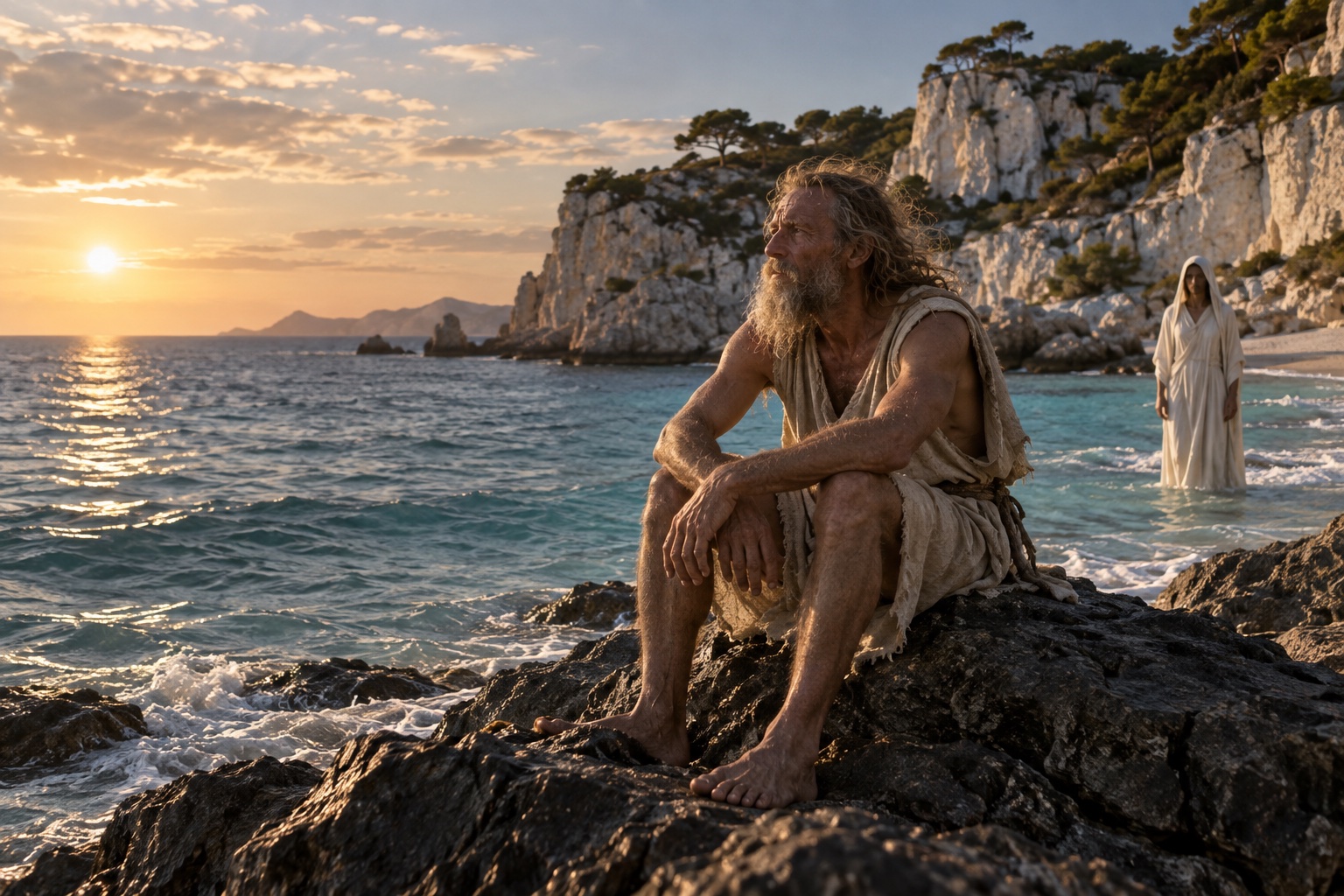
On screen: A gaunt long-haired castaway sitting on a rock by a turquoise lagoon at sunset; far behind him a hooded figure in white linen stands in the surf.
IΩΓΥΓΙΗ
The Island
οἴκαδέ τ᾽ ἐλθέμεναι καὶ νόστιμον ἦμαρ ἰδέσθαι
Od. 5.220“to reach home, and see the day of return.”
Seven years on an island where nothing happened. A goddess offered him a life without end on a single condition — that he stop remembering. He had very nearly agreed. Then a stranger in white linen stood in the surf and said his name, and he had to think before he knew it was his.
Memory is the mother of the Muses.
Everything that follows is something he could not stop remembering.
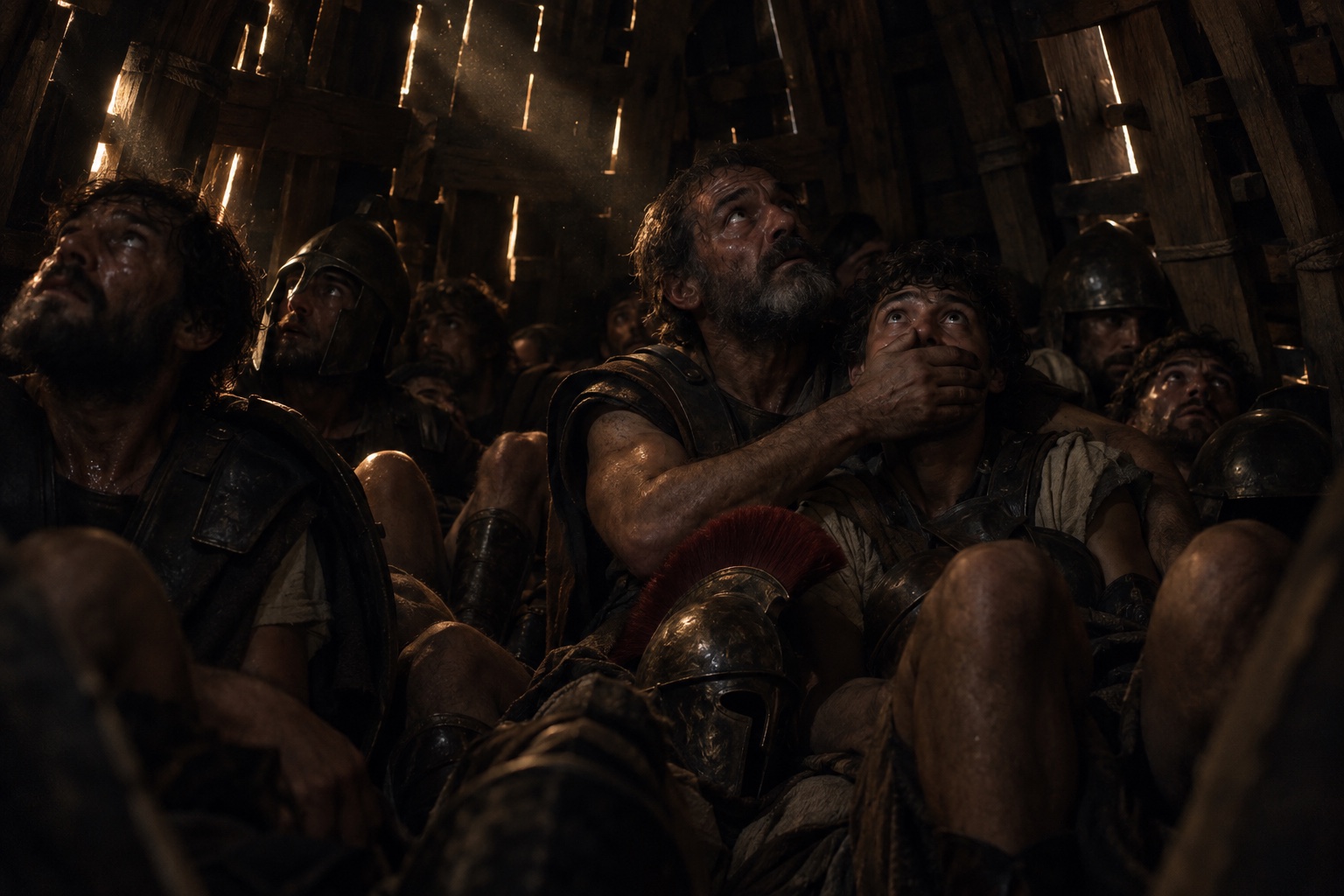
On screen: Soldiers crammed inside the dark wooden horse, lit by blades of torchlight; one man holds his hand over a young soldier's mouth.
IIΙΠΠΟΣ
The Horse
ἵππου κόσμον ἄεισον δουρατέου
Od. 8.492“sing of the wooden horse.”
The war was won by men agreeing not to exist for one night — folded into a timber gut, breathing through their teeth while a city celebrated outside. Years later a blind singer told the story to his face, not knowing who he was, and the man who had devised it pulled his cloak over his head and wept.

On screen: A mudbrick citadel burning at night seen from its walls, the wooden horse standing dark in the central square.
IIIΙΛΙΟΣ
The Sack
Τροίης ἱερὸν πτολίεθρον ἔπερσε
Od. 1.2“he sacked the sacred citadel of Troy.”
Homer calls the city sacred in the same line that says he burned it. The poem never lets the victory stand alone: somewhere in that fire a line was crossed, and every storm that follows is the sea keeping count.

On screen: Archaic terracotta relief of the wooden horse on wheels, warriors looking out of small windows in its body.
ΠΙΘΟΣ
Terracotta, after the Mykonos pithos, c. 670 BC — among the earliest pictures of the horse that survive. Within a few lifetimes the fire had cooled into clay, and the clay outlasted the city.

On screen: A colossal one-eyed giant crouching by a dying fire in a sea cave while armoured men with a torch press against the rock.
IVΚΥΚΛΩΨ
To leave the cave alive he had to become no one, and it worked. Then, safe at the oars, he shouted his real name back across the water — and the giant's father was the sea. Being nobody had cost him nothing. His name cost him ten years.
Οὖτις ἐμοί γ᾽ ὄνομα
Od. 9.366“Nobody is my name.”

On screen: Giants in silver armour with helmets like sea creatures stand among misty pines above a lone warrior.
VΛΑΙΣΤΡΥΓΟΝΕΣ
Not Like Men
οὐκ ἄνδρεσσιν ἐοικότες, ἀλλὰ Γίγασιν
Od. 10.120“not like men, but like Giants.”
Here cleverness runs out. There is no trick for this forest and no name to hide behind, and most of his fleet is gone before noon. The oldest lesson in Greek arrives without ceremony: some things are simply larger than you.

ΚΥΛΙΞ
Look into the cup long enough and it looks back.
Red-figure kylix, after Athenian painters of c. 490 BC

On screen: A grey-haired enchantress in a saffron robe holds a bronze cup in a torchlit hall full of pigs and half-transformed men.
VIΚΙΡΚΗ
The Cup
αὐτὰρ νοῦς ἦν ἔμπεδος ὡς τὸ πάρος περ
Od. 10.240“but their minds stayed as they had been.”
The horror is not that his men became swine. It is that they were still themselves inside — every thought intact and nothing left to think it with. Circe's cup does not change who you are. It takes away the part of you that could act on it.

On screen: Pale shades of soldiers walk out of the mist on a black sand beach toward a kneeling man holding a sword over a pool.
VIIΝΕΚΥΙΑ
The Dead
βουλοίμην κ᾽ ἐπάρουρος ἐὼν θητευέμεν ἄλλῳ
Od. 11.489“I would rather work the soil for another man.”
Achilles chose a short life and endless glory. Among the dead he takes it back: better the poorest labourer above ground than king of every shade below. The greatest of the heroes, correcting his own legend.

On screen: A man lashed to the mast of a ship in thick fog while rowers with sealed ears pull below and pale women rise from the water.
VIIIΣΕΙΡΗΝΕΣ
The Sirens do not promise pleasure. They promise to sing him his own story — all of Troy, perfectly. That is the trap: a man can be drowned by the version of himself he most wants to hear. So he has himself tied to the mast, and listens.
δεῦρ᾽ ἄγ᾽ ἰών, πολύαιν᾽ Ὀδυσεῦ, μέγα κῦδος Ἀχαιῶν
Od. 12.184“come here, famous Odysseus, great glory of the Achaeans.”
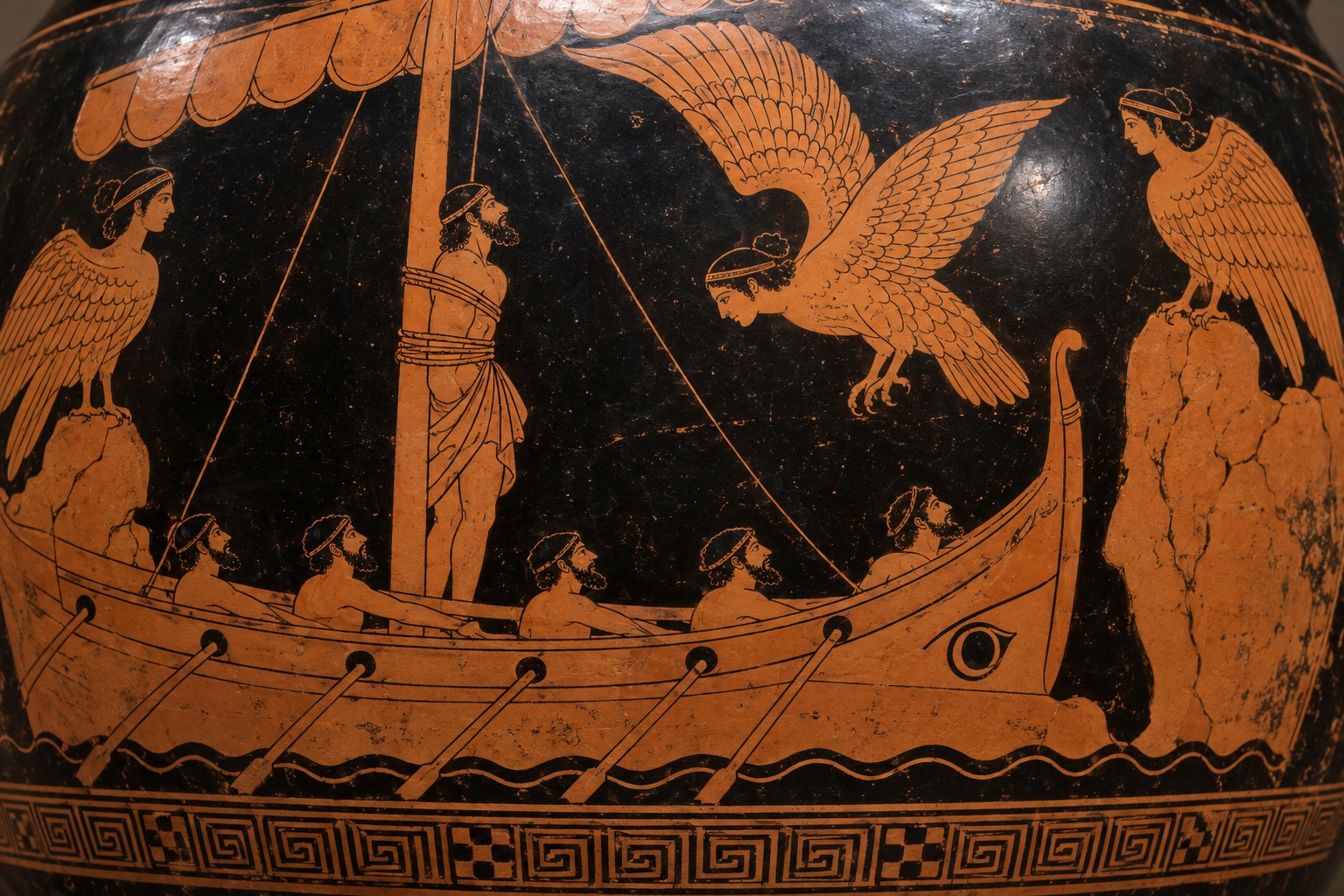
On screen: Red-figure vase painting of Odysseus bound to the mast while bird-bodied sirens perch on rocks.
ΣΤΑΜΝΟΣ
Red-figure, after the Siren Painter, c. 480 BC. The film dissolves back into the myth it came from — the painter already knew the only way through was to listen, bound.
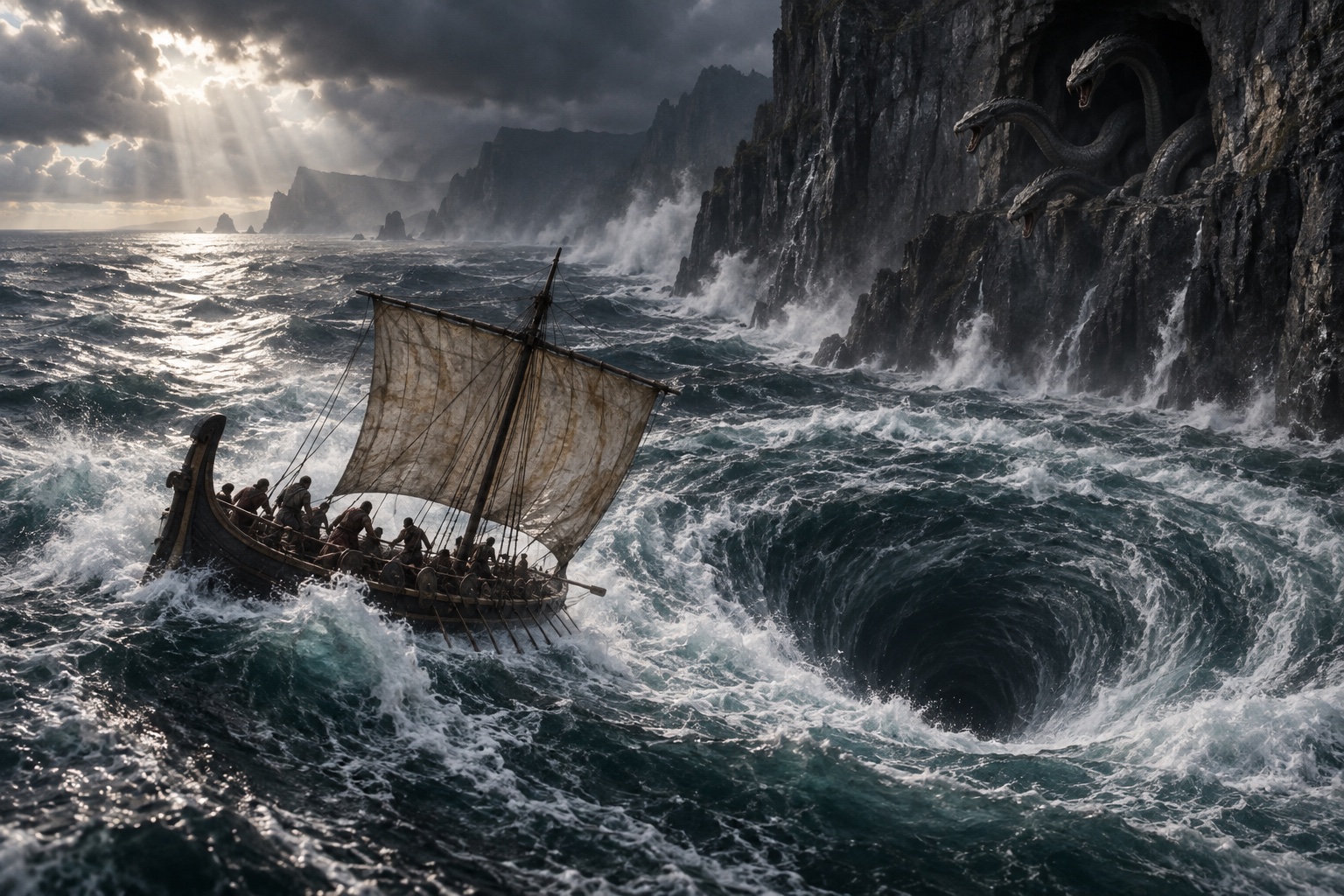
On screen: A small galley on the rim of an immense whirlpool beside a black cliff where serpent necks emerge from a cave.
IXΧΑΡΥΒΔΙΣ
The Strait
ἔνθεν μὲν Σκύλλη, ἑτέρωθι δὲ δῖα Χάρυβδις
Od. 12.235“on one side Scylla, on the other, dread Charybdis.”
Two disasters and no course between them that loses nothing. He steers toward the monster that will take six men rather than the whirlpool that will take the ship — and does not tell the crew. Leadership in its oldest form: choosing whom to lose.

On screen: A beggar kneels in a palace gateway at sunset beside an ancient grey hound lifting its muzzle toward him.
XΑΡΓΟΣ
Recognition
αὐτίκ᾽ ἰδόντ᾽ Ὀδυσῆα ἐεικοστῷ ἐνιαυτῷ
Od. 17.327“the moment he saw Odysseus, in the twentieth year.”
He came home disguised so well that no one knew him — except an old dog lying on the dung heap, who lifted his head, moved his tail, and died. The first to recognise him asks for nothing. Odysseus turns his face away so no one sees him weep.

On screen: A woman in a red and lapis-blue pleated gown unpicks her weaving at a great upright loom by lamplight.
XIΙΣΤΟΣ
In Greek the word for her loom and the word for the mast he was tied to are the same: histos. By day she wove a shroud; by night she unpicked it — three years of work that went nowhere on purpose. He survived by moving. She kept a home to come back to by refusing to finish.
δοιαὶ γάρ τε πύλαι ἀμενηνῶν εἰσὶν ὀνείρων
Od. 19.562“there are two gates of fleeting dreams.”
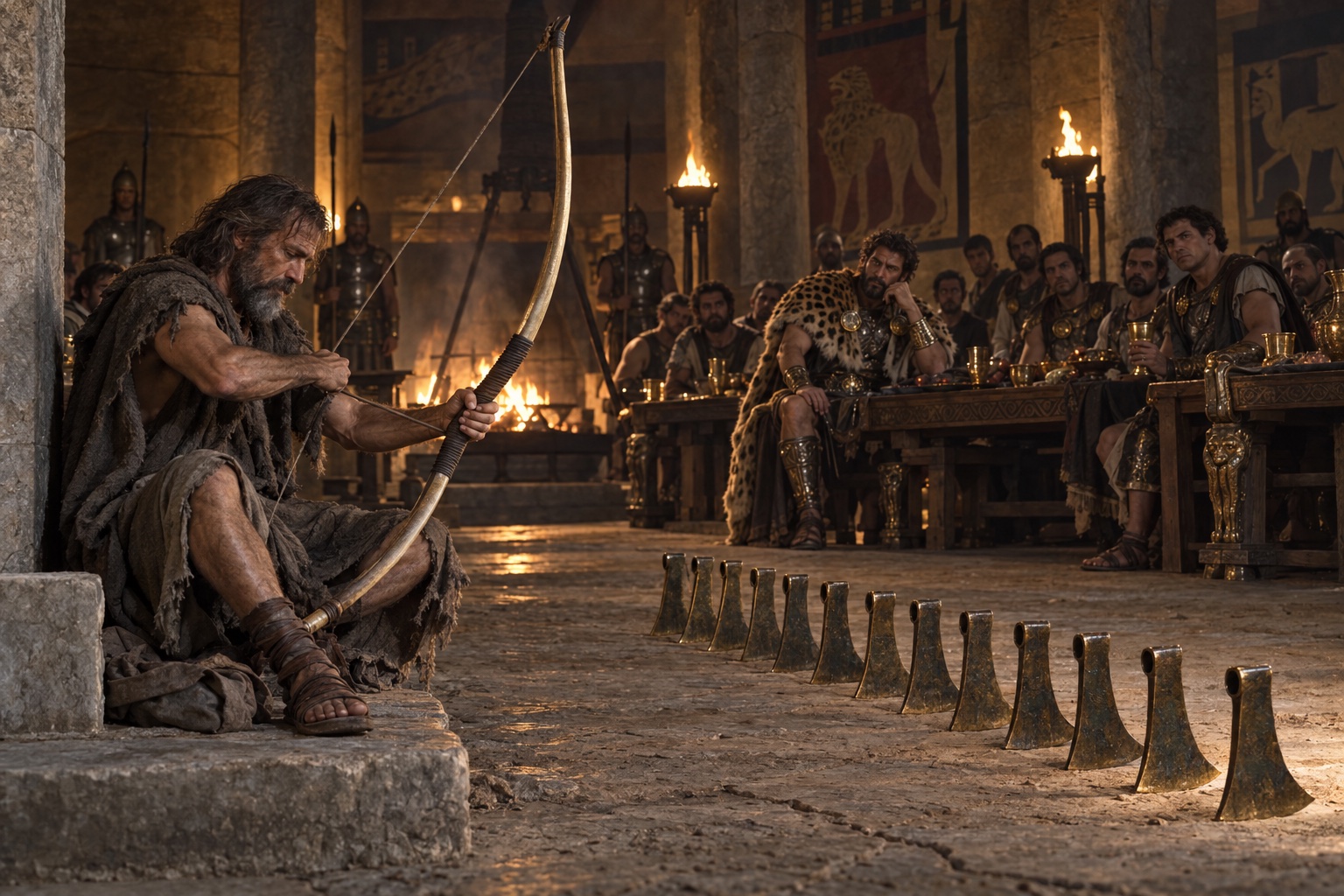
On screen: A ragged beggar on a stone threshold strings a great bow in a torchlit hall; twelve axe heads stand in a row in the floor.
XIIΤΟΞΟΝ
The Bow
ὣς ἄρ᾽ ἄτερ σπουδῆς τάνυσεν μέγα τόξον Ὀδυσσεύς
Od. 21.409“so, without effort, Odysseus strung the great bow.”
Homer compares it to a singer fitting a new string to his lyre. The most violent scene in the poem begins as an act of tuning: one note, plucked, and the hall falls silent, because every man in it knows the sound.

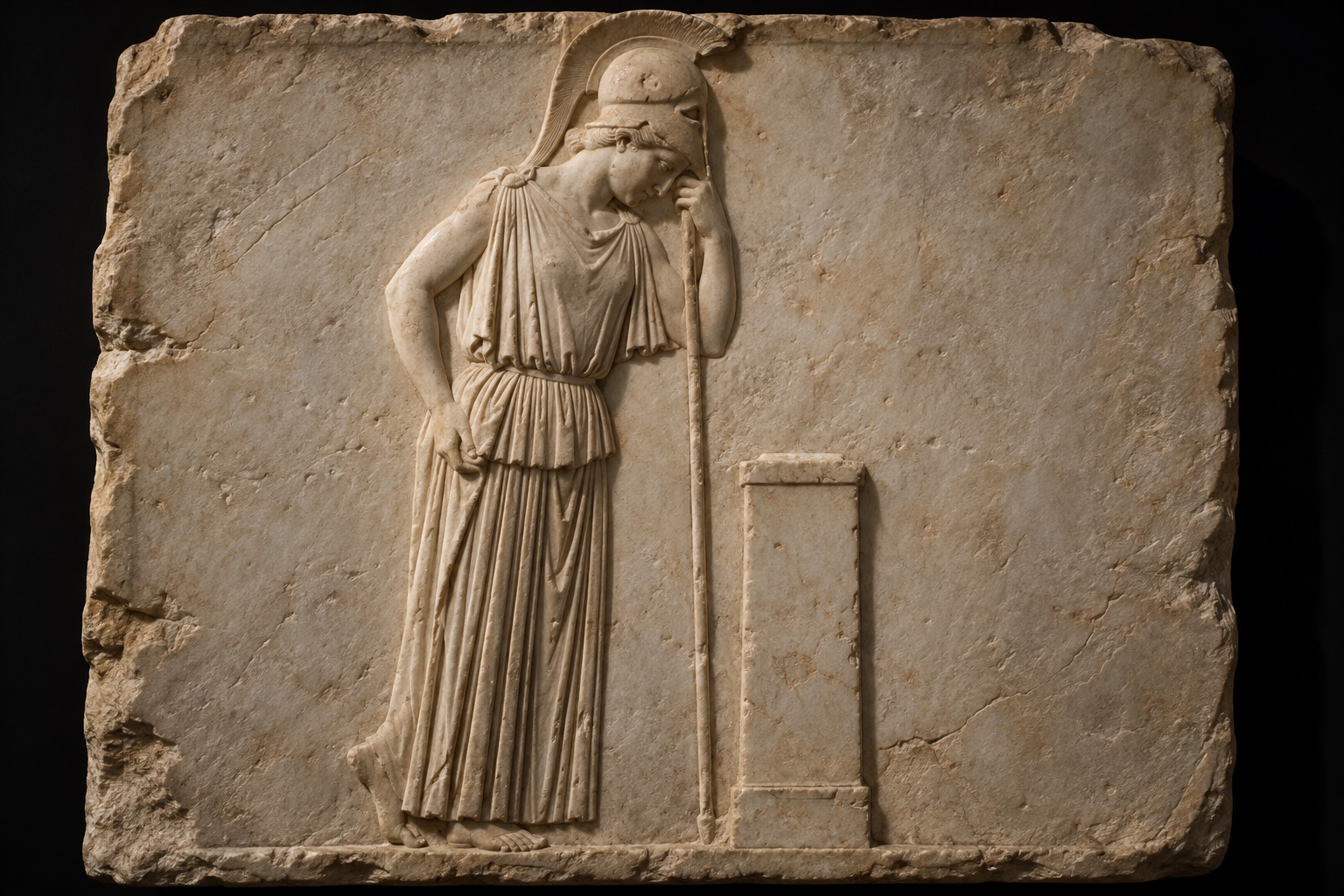
ΑΘΗΝΑ
σφῇσιν ἀτασθαλίῃσιν ὑπὲρ μόρον ἄλγε᾽ ἔχουσιν
Od. 1.34“by their own recklessness they suffer beyond their share.”
In the first scene of the poem Zeus complains that mortals blame the gods for what they do to themselves. Everything after is Homer testing whether he was right.
Marble, after the “Mourning Athena”, c. 460 BC

On screen: A small square-sailed ship heading into the setting sun with a man and a woman standing on its stern.
XIIIΝΟΣΤΟΣ
West
θάνατος δέ τοι ἐξ ἁλὸς αὐτῷ ἀβληχρὸς μάλα τοῖος ἐλεύσεται
Od. 11.134“death will come to you from the sea — gently.”
He won everything back and gave it away: the throne to his son, the hall to the living. He and Penelope sail west, toward the place where the sun goes down and the dead are remembered, to learn whether the sea will let a man be forgotten.